
A prospective client can find your firm through a referral, a Google search, or an advertisement and still pause before calling. What happens when they look up your name? A thoughtful review, an unanswered complaint, or a public argument can become part of that decision. Your marketing may earn the visit; your reputation needs to support the next step.
Attorney reputation management is the ongoing work of monitoring public feedback, addressing legitimate concerns, encouraging honest reviews where permitted, and challenging content that violates platform rules. For lawyers, that work also needs a confidentiality safeguard. A response written to defend the firm should not create a second problem by revealing information about a client.
Reviews have a specific role in local SEO: Google says review volume and positive ratings can help local ranking as part of prominence. That does not make a star rating a substitute for relevance, location, or the rest of your marketing. The useful goal is a credible public record and a better path from research to a qualified inquiry.
The distinction that matters: A negative review is not automatically a policy violation. A removed review is not automatically a new client. Manage reputation, platform compliance, and intake outcomes as related but separate responsibilities.
What current review research tells law firms
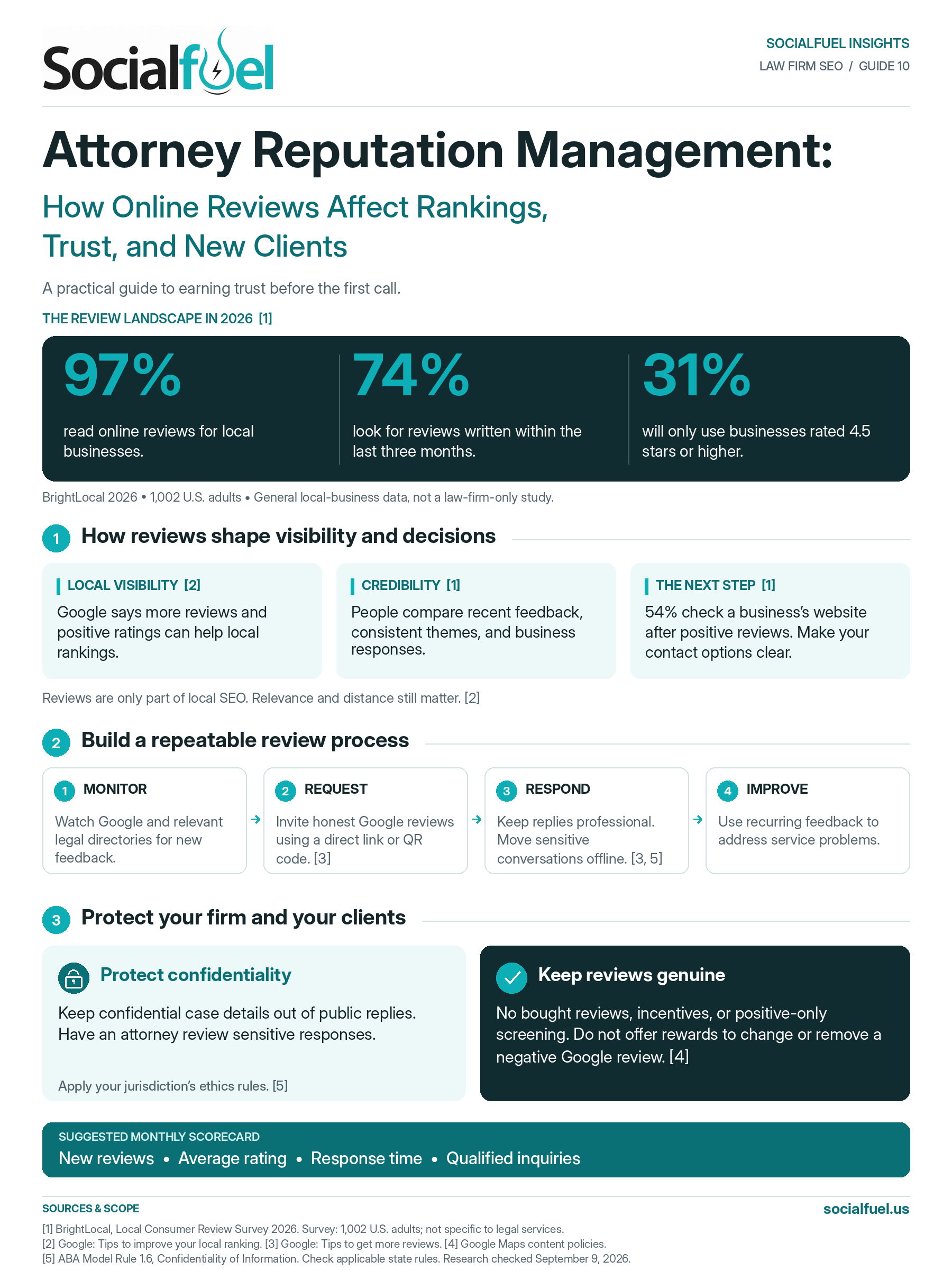
BrightLocal’s 2026 survey of 1,002 U.S. adults offers useful context for how people evaluate local businesses. Three findings are particularly relevant to planning a reputation program.
Reported finding Why it matters to your planning
- 97% read reviews for local businesses. Treat the review profile as part of the first impression, not an afterthought.
- 74% seek reviews written within the last three months.
- 54% check a business’s website after reading positive reviews.
- Review the recent feedback, not only the lifetime average.
- Make sure the next page answers questions and makes contacting the firm straightforward.
These are self-reported, cross-industry findings-not attorney hiring rates or proof of a particular increase in cases. Use them to decide what to inspect. Do not turn them into promises about how many clients a review campaign will produce.
How reviews affect rankings, trust, and new clients
Local visibility. Google describes local ranking through relevance, distance, and prominence. Reviews and ratings can contribute to prominence, but Google also says there is no way to request or pay for a better local ranking. Avoid proposals that assign a guaranteed ranking improvement to a fixed number of reviews.
Trust. Read the substance of feedback rather than treating every five-star rating as equally informative. In your own audit, look for recurring themes: whether people understood the next step, whether calls were returned, and whether expectations were clearly explained. Those observations give your team something concrete to improve.
Client acquisition. Put reputation beside the rest of the intake process. Are the right people finding the firm? Can they reach someone? Does the firm handle their issue? Are consultations becoming signed matters? A stronger review profile cannot compensate for a disconnected phone number or an intake process that sends suitable prospects elsewhere.
Start with an audit, not a deletion promise
We recommend reviewing the public journey a prospective client can actually take. Search the firm name, the names of public-facing attorneys, and the principal office locations. Record the review platforms and directory profiles that appear. Prioritize the profiles people encounter rather than opening accounts everywhere simply to increase a count.
For each priority profile, keep a baseline: its URL, rating, review count, dates of recent feedback, unresolved complaints, response owner, and account-access status. Keep individual review URLs and screenshots when an issue may need investigation. Give access only to the staff and vendors who need it; a working marketing report should not become a copy of the firm’s case files.
Then separate the findings into three work queues: service problems to fix, feedback that may warrant a restrained response, and potential policy violations to assess. A complaint about missed calls belongs in an operational review even when the team dislikes the wording. Mixing every unhappy comment into a removal queue hides problems the firm could actually solve.
Respond without exposing confidential information
A lawyer’s public response needs a different standard from an ordinary customer-service reply. Texas Ethics Opinion 662 addresses a former client’s negative online comments directly: a lawyer may not reveal confidential information merely to rebut the review. The opinion allows a proportional, restrained response that does not reveal confidences or otherwise violate the rules.
For a Houston or other Texas firm, that is an important guardrail. Firms elsewhere should check the rules and ethics guidance governing their lawyers. A reviewer’s decision to disclose details is not a reason for the marketing team to assume it may publish the file in return. Route sensitive reviews to the responsible attorney before posting.
Our recommended approval process is simple: identify the issue privately, decide whether a public reply is appropriate, draft the shortest useful response, and obtain attorney approval. Do not argue over a settlement, fee dispute, immigration history, medical condition, criminal allegation, or family situation in a review thread. Do not let an automated tool post case-specific replies without review.
Google recommends professional, concise replies and protecting private information. For lawyers, an appropriate response may acknowledge feedback without confirming representation or debating the underlying facts. The purpose is to show that concerns have a private route for attention-not to win a public argument.
Illustrative wording for attorney review: “We take feedback seriously. Privacy obligations limit what we can discuss publicly. Please contact our office directly so the appropriate person can review your concern.”
That is a drafting example, not a universal legal safe harbor. Depending on the circumstances, a private response or no public response may be preferable. Approval authority should stay with the firm, including when an outside agency prepares the wording.
Ask for honest feedback without manipulating it
Google permits businesses to request genuine reviews and provides review links and QR codes. Build an optional request into an appropriate point in the client experience, using an attorney-approved message and communication channel. Make the invitation understandable and easy to decline. A public review should never feel like a condition of receiving attention from the firm.
Do not screen people by satisfaction and send only the happy ones to Google. That practice is often called review gating. Google prohibits selectively soliciting positive reviews, discouraging negative feedback, and incentives for reviews or their revision or removal. It also prohibits pressuring reviewers to include specific content.
A neutral request could say: “You are welcome to share an honest review of your experience. Participation is optional. Please avoid confidential or sensitive information in any public post.”
Use the platform’s actual review link after the message. Leave the rating and wording to the reviewer. Do not supply city-and-practice-area keywords, write a testimonial for someone to paste, or offer a gift card for a favorable rating. Private feedback collection can help improve service, but it should not become a filter that diverts criticism away from a permitted public-review invitation.
Treat platform rules and the law as separate requirements. The FTC’s consumer-review rule addresses fake reviews and incentives conditioned on a particular sentiment; its guidance also makes clear that reputation management companies can face liability. Google’s no-incentive policy is broader than the FTC rule’s sentiment based restriction. Before extending a request workflow to another platform, check that platform’s rules rather than assuming Google’s process applies everywhere.
Which negative reviews can be removed?
The starting question is whether the content violates a platform rule-not whether it hurts the firm’s rating. Google says only policy-violating reviews are eligible for removal and advises against reporting a review simply because the business disagrees with it. A professional service should explain the relevant policy and evidence, not advertise a secret route to deleting criticism.
Potential grounds include fabricated experiences, a demonstrable conflict of interest, threats, prohibited personal information, or off-topic content. Eligibility depends on the actual wording and circumstances. An unfamiliar display name alone does not establish that a review is fake. Consider whether the person had a genuine interaction, such as an intake conversation, even if the firm never accepted the matter.
For a potentially reportable review, preserve the URL, date, text, screenshots, and relevant non-confidential evidence. Map the concern to a specific rule. Google’s process allows reporting through the Business Profile or Reviews Management Tool, checking the decision, and submitting a one-time appeal when available after rejection. Keep the evidence focused; have the attorney approve anything that might reveal protected information.
Maintain distinct statuses such as under review, submitted, pending, declined, appealed, and removed. Those labels make reporting honest: filing a report is work completed, but it is not a successful removal. When a review remains, decide what operational improvement or permissible response is still useful instead of promising that repeated complaints will eventually force a deletion.
Treat review extortion as a separate issue
A demand for money or favors in exchange for removing reviews needs a different response from ordinary criticism. Google advises businesses not to pay or engage with the malicious party, to preserve evidence, and to use its dedicated extortion-reporting process. That channel is specifically for actual extortion attempts. Preserve the demands and related review links; do not mislabel a routine negative review as extortion.
Make the website support the reputation
A review may send someone to your site looking for reassurance. Our recommendation is to make that visit useful: keep attorney biographies current, describe services accurately, explain the next step, and make the office easy to contact. Favor verifiable credentials and clear information over generic claims that the firm is “the best.”
Reusing a review in an advertisement or on the firm’s website is not merely hosting a third-party opinion. The FTC distinguishes consumer reviews from testimonials used in marketing, and false testimonials can create liability. Check permission, context, and applicable attorney-advertising requirements before republishing. Avoid edits that change the meaning or imply that a past result predicts another person’s outcome.
Do not confuse a Business Profile rating with review stars attached to your website’s organic search result. Google’s structured-data rules make self-serving reviews about an Organization or LocalBusiness ineligible for the review-star feature, including reviews displayed through a third-party widget. A testimonial can be useful to readers without qualifying the firm’s page for search-result stars.
Measure the work and the business outcome separately
Start with a baseline and a consistent reporting period. For reputation work, track new reviews, recent sentiment, recurring complaints, response handling, and the status of policy reports. We recommend recording the service improvement behind a complaint as carefully as the public reply. A closed issue should mean something changed, not simply that someone answered it.
For local visibility, use profile views and interactions as leading indicators. Google’s Business Profile “Calls” metric counts clicks on the call button, not confirmed conversations or signed clients. Its performance data can also include activity from both organic results and Google Ads. Do not label every profile interaction as an organic lead or attribute it all to review work.
Connect those observations to intake records: new prospect or existing client, qualified or unsuitable, consultation held or missed, matter signed or declined. Ask how the prospect found the firm and what they checked before contacting you, without assuming they can precisely reconstruct every marketing touchpoint. Keep legal details in the firm’s approved systems.
For example, 25 signed matters from 100 qualified inquiries is a 25% qualified-inquiry-to-signed-matter rate. Thirty signed matters from the same number would be 30%. That hypothetical five-percentage-point improvement is useful arithmetic, not proof that reviews caused five additional matters. Changes in practice-area mix, staffing, pricing, seasonality, or advertising could also explain the difference.
A practical 90-day reputation plan
The following is a suggested work sequence, not a deadline for a rating increase or review removal. Adjust it to the firm’s size, review volume, and approval requirements.
Period Primary work Evidence of progress
- Days 1–30 Audit priority profiles, confirm access, assign an attorney approver, establish a baseline, and assess urgent concerns.
- Days 31–60 Introduce a permitted, neutral feedback process; address recurring service issues; prepare approved responses and
qualifying reports. - Days 61–90+ Review decisions, pursue available appeals where justified, compare feedback themes, and connect reporting to intake.
What SocialFuel’s reputation service actually includes
- A documented inventory, clear ownership, and an evidence-backed issue queue.
- A consistent workflow, completed operational fixes, and accurate report statuses.
- A record of work performed and a clearer view of qualified inquiries and signed matters.
SocialFuel’s Law Firm Reputation Management is $1,500 per month. The standalone service is a policy-based review-removal campaign: each month, we identify and pursue one qualifying negative review, with one active removal case at a time. Additional reviews can be scoped separately. This is a removal target, not a guaranteed monthly deletion.
The work moves through review selection, policy and evidence assessment, submission, appropriate escalation or appeal, and confirmation when removal occurs. Covered platforms can include Google Business Profile, Avvo, Yelp, Facebook, BBB, and Trustpilot where a qualifying process is available. The platform—not SocialFuel—decides the outcome.
The wider reputation program described in this article also includes honest feedback, careful responses, service improvement, and measurement. Do not assume every activity is included in the standalone removal service. Confirm responsibilities and scope before buying, particularly for multiple offices, additional reviews, response management, or ongoing content.
For clients buying SocialFuel’s separate Law Firm Local SEO service at $3,000 per month, an existing Google Business Profile below 4.5 stars requires the additional $1,500 monthly reputation service, bringing that combination to $4,500 per month. The 4.5-star threshold is SocialFuel’s service requirement—not a Google eligibility rule or a promise of a particular ranking.
View Law Firm Reputation Management and buy online. For profile management and broader local-search work, review the separate Law Firm Local SEO service. Choose the work that matches the problem rather than buying a vague promise to “fix your reputation.”
Frequently asked questions
Is one bad review enough to justify reputation management?
Assess its visibility, substance, and the firm’s existing review profile. One prominent review may deserve attention, but attention does not always mean paid removal work. A service issue, a permissible response, and a policy report are different remedies.
Can a provider guarantee removal or a five-star rating?
No provider controls Google’s moderation decision, and disagreement is not itself a removal ground. [6] SocialFuel does not guarantee removals, star-rating improvements, rankings, or new cases. [11] Ask for the scope and evidence standard instead of a promised outcome.
How quickly can a review be removed?
Google says review evaluation typically takes several days, while appeals add another decision stage. [6] SocialFuel’s service materials note that some cases take several weeks. [11] There is no reliable universal removal deadline.
Should a law firm respond to every review?
Review every entry, but do not adopt an automatic public-reply rule. Some situations call for attorney review, a private response, or silence. A restrained response must still respect confidentiality and the rules governing the firm. [3]
Build a reputation worth finding
The best reputation strategy begins with a service experience the firm can stand behind. Make it easier for genuine feedback to surface, give concerns a responsible owner, and challenge rule-breaking content through the proper channels. Keep the response process as disciplined as the rest of your practice.
Search visibility gets your firm considered. A credible public record and a dependable intake process help a prospective client decide what to do next. Protect all three, and judge the campaign by documented work and real opportunities—not by a star count alone.
Sources and service notes
External sources checked September 9, 2026. Statistics describe the cited consumer survey, not law-firm results. Examples and the 90-day plan are illustrative. Service prices and scope reflect SocialFuel’s approved 2026 materials. This article is general marketing information, not legal advice; the firm should review applicable professional rules and platform policies. Rankings, removals, ratings, leads, and signed matters are not guaranteed.
[1] Google Business Profile Help, “Tips to improve your local ranking on Google.”
[2] BrightLocal, “Local Consumer Review Survey 2026,” February 11, 2026. Survey of 1,002 U.S. adults via SurveyMonkey; not a law-firm-specific study.
[3] Texas Professional Ethics Committee, Opinion 662, August 2016, published by the Texas Center for Legal Ethics. [4] Google Business Profile Help, “Tips to get more reviews.”
[5] Google Maps User Generated Content Policy, “Prohibited & restricted content,” including fake engagement and rating manipulation. [6] Google Business Profile Help, “Report inappropriate reviews on your Business Profile.”
[7] Google Business Profile Help, “Report negative review extortion scams on your Business Profile.”
[8] Federal Trade Commission, “The Consumer Reviews and Testimonials Rule: Questions and Answers.”
[9] Google Search Central, “Review snippet structured data,” including self-serving review restrictions.
[10] Google Business Profile Help, “Understand your Business Profile performance & insights.”
[11] SocialFuel, “Law Firm Reputation Management,” approved 2026 service materials, pages 1–2. Commercial scope and pricing. [12] SocialFuel, “Law Firm Local SEO,” approved 2026 service materials, pages 1–2. Local SEO pricing and reputation add-on requirement.