
A prospective client does not need another article announcing that your firm is experienced. They need an answer: what to do next, which documents matter, how a process works, or when their situation calls for legal help. Your content should make that answer easier to find and the next decision easier to make.
Law firm content marketing is the planned creation, publication, and distribution of useful information for the people your firm wants to serve. It includes practice-area pages, articles, attorney insights, guides, visual resources, and appropriate off-site publishing. The business objective is not simply more pages. It is more relevant opportunities that your intake team can evaluate.
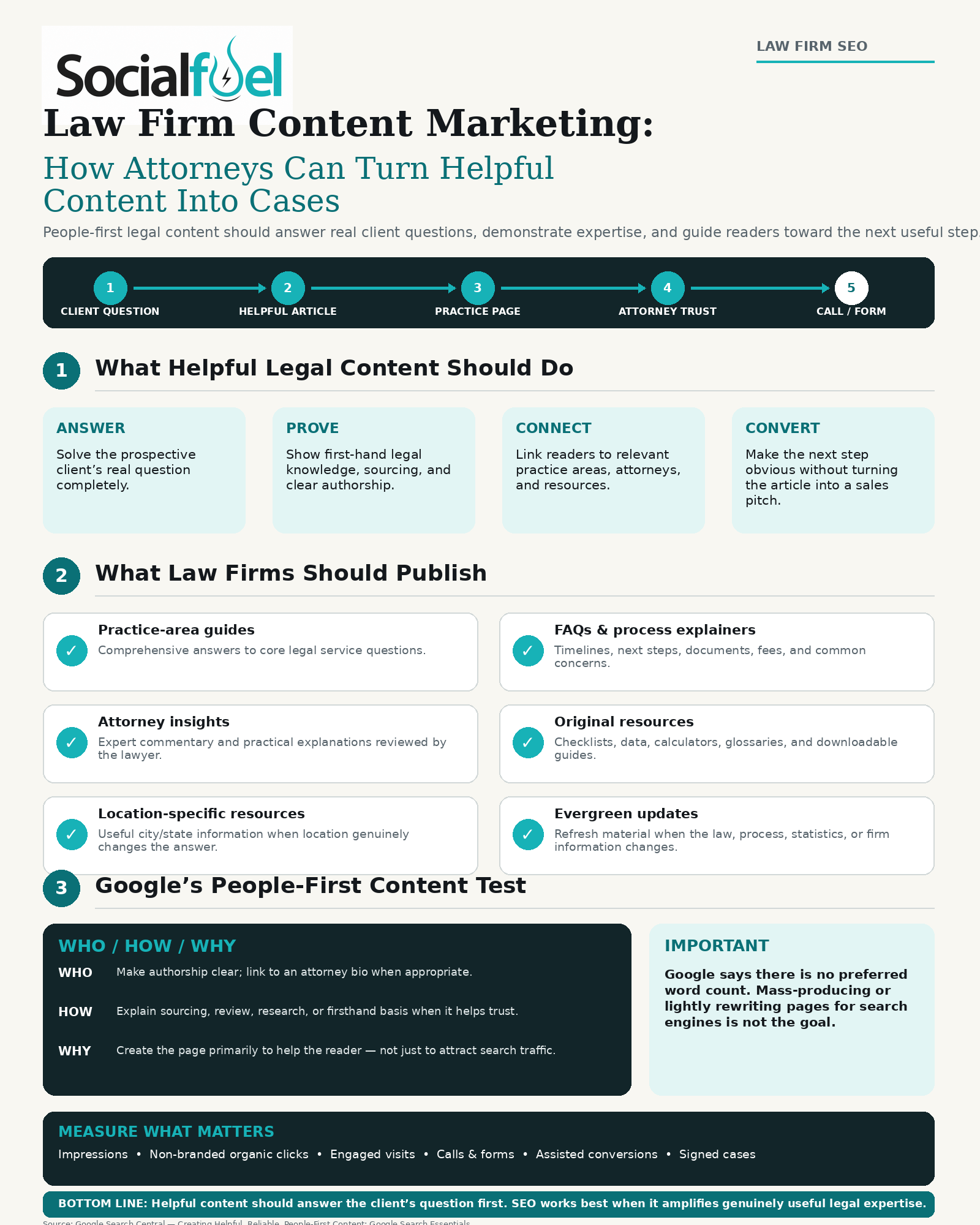
Google’s guidance favors helpful, reliable content created for people rather than material produced mainly to manipulate rankings. That makes substance the starting point, not an optional finishing touch. [1] Here is how to connect that principle to a practical content program for your firm.
The goal: Answer a real question, demonstrate why your firm is worth considering, and offer a clear next step. A visit, a lead, and a signed case are three different outcomes.
Start with the matters your firm actually wants
Before approving a publishing calendar, define the practice areas, locations, client needs, and types of matters you want to pursue. Decide what the firm does not handle, too. A page that attracts the wrong inquiries can consume intake time without advancing your business goals.
We recommend beginning with questions your attorneys and intake team already hear. Remove client identifying details, then group the questions by the decision behind them: understanding a problem, preparing for a conversation, comparing representation, or taking action. Keyword research can refine the language; it should not replace that practical knowledge.
Give each proposed page a job. Record its intended reader, main question, relevant jurisdiction, supporting service page, reviewer, and next step. When two drafts answer substantially the same question for the same audience, consider improving one useful page instead of publishing two competing versions.
Match the content to the reader’s next decision
Reader’s need Useful content Appropriate next step
- Understand the situation A focused explanation of a legal process or issue. Read a related practice-area guide.
- Prepare to seek help A document checklist or explanation of the first meeting. Review the firm’s intake instructions.
- Evaluate the firm A relevant attorney bio and a clear service page. Learn who handles this type of matter.
- Discuss representation Accurate contact options and an explanation of what happens next. Call or submit a secure inquiry.
This is a planning framework, not a promise that every visitor follows a straight line. Some readers need one answer and leave. Others may return later or share the resource with someone who needs an attorney. Make each page useful on its own while providing relevant connections.
Build a focused library, not a pile of unrelated posts
A strong starting plan combines service pages with supporting answers. The service page explains what the firm handles and how to inquire. Supporting articles address narrower questions that would make that page unwieldy. Attorney profiles establish who is responsible for the work. Resources help people prepare or understand their options.
For the five practice areas SocialFuel serves, possible topics might include the following. These are editorial examples, not legal advice or descriptions of actual client matters.
Practice area Example content topic Related destination Personal injury What to bring to a first meeting after a car crash. Car accident representation page.
- Immigration Documents to discuss at an initial family-based immigration consultation.
- Family immigration service page.
- Family law How to prepare for a first meeting about divorce. Divorce representation page.
- Criminal defense Questions to ask when choosing defense counsel. Relevant defense service and attorney pages.
- Business law Records to organize before discussing a contract dispute.
- Commercial litigation or contract-dispute page.
Choose specific questions you can answer responsibly. A headline about a filing deadline needs current jurisdiction-specific review; it should not be published from a generic template. A city page should explain a genuine service relationship or useful local context, not merely swap Houston for another city. Google identifies substantially similar doorway pages as a spam concern. [4]
Make your resources worth keeping
A useful checklist, glossary, comparison table, or original analysis can do more than decorate an article. It gives the reader something they can use. For an original data project, state where the data came from, the period covered, the method, and its limitations. A visual should explain the evidence rather than make unsupported numbers look authoritative.
Publish the main explanation as readable web text. Let an infographic summarize it and let a PDF provide a convenient copy, rather than making either the only way to understand the page. Google’s AI-search guidance specifically recommends making important content available in textual form. [7]
Build attorney review into the production process
Your firm’s experience should shape the substance, not just appear in the byline. An interview can uncover recurring misconceptions, useful distinctions, and the questions people forget to ask. Turn those insights into clear explanations that a prospective client can understand without already knowing legal terminology.
Google encourages accurate authorship, clear sourcing, and demonstrable expertise. It describes experience, expertise, authoritativeness, and trustworthiness as E-E-A-T, while explicitly noting that E-E-A-T is not itself a single ranking factor. [1] A byline or credential box is not a shortcut around weak content.
Our recommended workflow is brief, research, draft, attorney review, publish, and maintain. The brief sets the reader and purpose. Research identifies primary sources. The draft answers the question. The attorney checks legal accuracy and firm claims. Publishing checks links and functionality. Maintenance revisits the page when its facts change.
Assign a named reviewer and a backup, establish a review window, and keep a record of approvals. Use “reviewed by” only when the named attorney actually reviewed the piece. Distinguish general information from situation-specific advice, and identify the jurisdiction when it changes the answer.
Protect confidentiality and avoid misleading claims
As a model-rule baseline, ABA Model Rule 7.1 addresses false or misleading statements about a lawyer or the lawyer’s services; Model Rule 1.6 addresses disclosure of information relating to client representation. [5][6] The firm should apply its governing jurisdiction’s rules and approval requirements rather than treating a general marketing checklist as legal clearance.
For client stories, testimonials, or case results, obtain appropriate authorization and review the context before publication. Do not invent a success story, imply a guaranteed outcome, or assume that removing a name makes a matter safe to describe. Use clearly labeled hypothetical examples when you need to illustrate a process without discussing a real client.
Use AI as assistance, not as publication approval
AI can help organize questions, produce an initial outline, or repurpose approved material. It should not determine whether a deadline, citation, quotation, or legal conclusion is correct. Require verification and attorney review before publication, including for content supplied by an outside agency.
Google’s scaled-content policy focuses on pages made primarily to manipulate rankings without helping users, regardless of how they are produced. Generating many low-value pages with AI is one listed example. [4] Replacing words in a competitor’s article is not a substitute for adding your firm’s own useful explanation.
Connect useful answers to a clear next step
An educational article should not force a sales pitch into every paragraph. Answer the question first, then offer a relevant route forward. A preparation guide can link to the service page that explains representation. An attorney biography can connect to the issues that lawyer handles. A detailed resource can include a clear inquiry option for readers who need individual help.
Use descriptive link text that tells the reader what comes next. Google recommends crawlable links, concise relevant anchor text, and an internal link to every important page from at least one other page on the site. [3] Avoid vague “click here” links when a phrase such as “our car accident representation services” accurately describes the destination.
Before publishing, test the entire path on a phone. Can a visitor read the article, find the relevant attorney, tap the phone number, and complete the form? Does the confirmation explain the next step accurately? Remove unnecessary friction, but do not promise immediate attorney contact unless the firm actually provides it.
Give the page a descriptive title, a clear main heading, and meaningful sections. Google’s SEO Starter Guide emphasizes useful organization and readable content. [2] Make visual resources accessible with explanatory text, and do not hide the central answer behind a promotional pop-up.
Distribute the content without confusing exposure with endorsement
Publication is one step, not the entire campaign. We recommend sharing appropriate resources through the firm’s existing channels, introducing them to relevant community or professional audiences, and preparing attorney commentary for publishers that cover the subject. Adapt the format to the audience rather than posting the same promotional paragraph everywhere.
Separate your own website content, paid or sponsored publishing, and independent editorial coverage in both the plan and the report. Each may serve a purpose, but a purchased placement is not an independent recommendation. A press-release distribution report is not proof that a reporter selected your firm as a source.
Google prohibits buying links to manipulate rankings and says advertising or sponsorship links should be appropriately qualified, such as with rel=”sponsored” or rel=”nofollow”. [4] Evaluate a placement for audience relevance, editorial fit, and useful referral opportunities, not solely for a domain metric or a promised ranking benefit.
For AI Overviews and AI Mode, Google says foundational SEO remains applicable; there is no special AI schema or additional optimization requirement that guarantees inclusion. [7] Build understandable, accurate resources rather than buying a promise that a particular system will recommend your firm.
Measure the progression from a page visit to a signed matter
A monthly report should distinguish visibility from business outcomes. Search Console reports impressions, clicks, click-through rate, and average position, with views by page and query. [8] Those numbers help diagnose discovery. They do not tell you whether a caller needs a service you provide or whether the firm ultimately accepts the matter.
We recommend reviewing the program at three levels: the topics attracting relevant searches, the actions readers take, and the matters the intake team qualifies and signs. Group related articles and service pages together so the report reflects a practice-area strategy rather than isolated pageview totals.
Google Analytics recommends events including generate lead for submitted inquiries and qualify lead for leads meeting your criteria. These require implementation; they do not automatically turn a form submission into a qualified case. [9] Test events, separate spam and existing-client contacts, and reconcile the meaningful outcomes with your intake records.
Illustrative example, not a performance forecast: 1,000 relevant visits × 3% inquiry rate = 30 inquiries. If 40% qualify, that is 12 qualified inquiries. If 25% of those become signed matters, the result is 3 matters. The assumed rates are not industry benchmarks.
This example shows why more traffic alone is not the goal. A content program can attract the wrong audience, while an otherwise effective page can lose opportunities through a broken form or poor follow-up. Diagnose the stage that is failing before ordering more articles.
Attribution also needs a rule: first visit, last visit, or another consistently defined approach. A reader may discover a guide and return through a branded search later. Do not count the same matter multiple times or claim that content caused every subsequent increase in cases.
Keep analytics separate from confidential intake details. Google’s standard Analytics guidance prohibits sending personally identifiable information in ordinary collection, including through URLs and user-entered fields. [10] Use non-identifying measurement and retain sensitive case information in the firm’s appropriately controlled systems.
Use the first 90 days to build a repeatable program
The following is a suggested work plan, not a promise of rankings or cases within 90 days. Set the volume around the firm’s research, review, and publishing capacity.
Period Priority Evidence of completion
Days 1–30 Audit existing content; choose priority matters; map topic gaps and supporting service pages.
Days 31–60 Create or improve the first focused resources; review legal accuracy; publish and link them.
Days 61–90 Distribute the material; review relevant searches and inquiries; address the next clear gap.
An approved plan, named reviewers, and a tracking baseline.
Live pages, documented approvals, and tested inquiry paths.
A performance review and an updated editorial plan.
Keep a record of what changed and when. Revisit a page when the law, procedure, source data, or firm information changes. Google warns against merely changing dates to make unchanged content appear fresh. [1] A maintenance log is more useful than a cosmetic “updated” label.
Choose the right SocialFuel content service
SocialFuel’s Monthly Content Package is $2,000 per month, month to month. It focuses on legal-focused articles, guest publishing, and contextual links beyond the firm’s own site. Topics and target pages are selected around your practice; formats, quantities, outlets, and timing are confirmed within the monthly budget before work begins. [11]
That distinction matters: the standalone package is not a full SEO campaign or a weekly onsite blogging subscription. Publisher approval and availability apply, and sponsored placements are not independent endorsements. The package is a fit when your firm needs coordinated off-site content and publishing with a defined scope. [11]
For a broader program, Starter SEO is $3,000 per month and includes the Monthly Content Package plus weekly onsite blogs, rank tracking and reporting, local citation building, and social media management and scheduling. Technical clearance is required before the monthly campaign begins; necessary repairs can be completed by your developer or purchased separately. [12]
Choose based on what is missing. An unclear service page needs improvement on your website. A site with useful resources but little outside exposure may need distribution. A firm that needs both regular publishing and coordinated SEO should compare the broader campaign scope rather than assuming all content services are interchangeable.
Frequently asked questions about law firm content marketing
How long should a law firm blog post be?
Long enough to answer its intended question clearly and accurately, without padding. Google says it has no preferred word count. [1] A focused checklist and a detailed practice guide can both be useful; they do not need the same length.
How often should we publish?
Set a cadence your firm can research, review, publish, and maintain. We recommend a manageable schedule of relevant pieces over a larger backlog of unreviewed drafts. Allocate time to improving existing pages as well as creating new ones.
How long does content take to affect SEO?
Google says site changes can be reflected in hours or take several months, and not every change produces a noticeable search impact. [2] Treat publication, indexing, visibility, inquiries, and signed matters as separate milestones rather than promising a fixed time to new cases.
Can a content agency take care of everything?
An agency can coordinate strategy, drafting, publishing, and reporting within its scope. The firm should still provide accurate practice information, identify a qualified reviewer, approve legal claims, and maintain intake follow-through. Specify these responsibilities before work starts.
Make every piece of content earn its place
The strongest content plan begins with a real client question and ends with a useful next step. Build around the matters you want, contribute genuine attorney knowledge, publish carefully, distribute responsibly, and measure qualified opportunities. More content is useful only when it serves a clear purpose.
Ready to put a defined plan in motion? Review SocialFuel’s Monthly Content Package and buy online for off site content and publishing, or compare Starter SEO when you also need weekly onsite blogs and ongoing SEO. Confirm the scope, review process, and technical requirements before work begins.
Sources and implementation notes
External sources checked September 9, 2026. Work plans and examples are SocialFuel recommendations, not industry benchmarks or promises of results. Commercial scope follows the approved 2026 service materials; written service terms apply. This article is marketing information, not legal advice.
1. Google Search Central, “Creating Helpful, Reliable, People-First Content”.
2. Google Search Central, “Search Engine Optimization (SEO) Starter Guide”.
3. Google Search Central, “Link Best Practices for Google”.
4. Google Search Central, “Spam Policies for Google Web Search” — Scaled content abuse, doorway abuse, and link spam.
5. American Bar Association, Model Rule 7.1, “Communications Concerning a Lawyer’s Services”.
6. American Bar Association, Model Rule 1.6, “Confidentiality of Information”.
7. Google Search Central, “AI Features and Your Website”.
8. Google Search Console Help, “Performance Report (Search Results)”.
9. Google Analytics Help, “GA4 Recommended Events”.
10. Google Analytics Help, “Best Practices to Avoid Sending Personally Identifiable Information (PII)”.
11. SocialFuel, “Monthly Content Package” — Approved 2026 service materials, page 1. Price, scope, and exclusions.
12. SocialFuel, “Frequently Asked Questions” — Approved 2026 service and billing materials, pages 1–2. Starter SEO scope and technical requirements. (Internal document; add its direct link if available.)