
Schema markup is not a secret ranking switch. It is a machine-readable way to describe the facts already visible on a web page: who the law firm is, who its attorneys are, where its offices are located, what a page is about, who wrote an article, and how pages relate to one another. Google describes structured data as a standardized format for providing information about a page and classifying its content. [1]
For a law firm, that matters because a modern website contains several different entities that can easily blur together. The organization is not the same thing as an individual attorney. A real office is not the same thing as a service area. A practice-area page is not another office. A blog article is not the law firm itself. Good structured data makes those relationships explicit without inventing facts or hiding claims in code.
The most useful way to think about schema is therefore simple: make the website easier for machines to interpret while keeping the markup faithful to what a client can actually see. Structured data can make pages eligible for supported search features, but valid markup does not guarantee a rich result, a ranking increase, an AI citation, or a new case. [2]
Bottom line: Schema should describe your real law firm more clearly. It should not create a second, invisible version of your firm for search engines.
What structured data actually does
Google uses structured data to understand the content of a page and information about people, organizations, and other entities described in the markup. [1] That can support richer search appearances for structured-data features Google currently supports.
There are two layers to understand. Schema.org provides a broad vocabulary for describing entities and relationships. Google supports specific structured-data features within that broader vocabulary. A type can be perfectly valid schema.org markup without producing a special Google rich result. That distinction is important when an SEO vendor promises that adding one particular schema type will automatically create stars, FAQs, or a special search box.
Google recommends JSON-LD as a structured-data format. [2] JSON-LD is usually placed in a script block in the page source, which makes it practical to maintain without wrapping every visible element in microdata attributes. The format choice does not excuse bad data: the markup still has to describe the page accurately.
Which schema types are useful for law firms?
| Markup | Where it fits | What it can describe | Important limitation |
| LocalBusiness / LegalService | Real office/location pages when the firm qualifies as a local business | Physical address, telephone, hours, location details, and the legal-service business entity. | Do not manufacture offices. LegalService is useful
schema.org vocabulary, but Google rich-result eligibility is feature-specific. [4] |
| ProfilePage + Person | Attorney biography/profile pages | The person the page is about, with links to the firm,
credentials, roles, and other accurate public details. |
An attorney bio should
describe a person, not pretend every lawyer is a separate office. [5] |
| Article / BlogPosting | Blog posts, legal explainers, news, and thought leadership | Headline, author, dates,
images, and publication information. |
Markup should identify the real author and match the visible article. [6] |
| BreadcrumbList | Pages within a clear site
hierarchy |
Where the page sits within the website structure. | Breadcrumbs help describe hierarchy; they do not replace good internal navigation. [7] |
| Service / LegalService | Practice-area and legal-service pages | The actual service offered and its provider or area served. | Useful semantic markup is not automatically a Google rich result feature. Do not promise a visual enhancement just because the schema validates. |
A law firm usually does not need every possible schema type on every page. The right markup follows the page purpose. The homepage may describe the organization. An office page may describe a qualifying local business location. An attorney bio can center on a Person. An article can name that attorney as the author. The practice page can describe the legal service and connect it back to the provider.
Model the firm, attorneys, offices, and services as different things
One of the most common structured-data mistakes is entity confusion. A site may generate Organization, LocalBusiness, Person, WebSite, Article, Service, and breadcrumb markup from several plugins at the same time, each using slightly different names, URLs, phone numbers, or identifiers. The code may validate syntactically while telling an inconsistent story.
A cleaner law-firm model starts with stable identities. Use one consistent firm name and canonical website URL. Give the main firm entity a stable @id. Give each real office its own stable identity when separate location markup is appropriate. Give each attorney a Person identity tied to the biography URL. Then connect articles, services, and pages back to those entities instead of rebuilding a new version of the firm on every URL.
The goal is not to maximize the number of schema nodes. It is to make the relationships easy to follow. If the same attorney writes ten articles, those articles should point back to the same attorney identity rather than ten slightly different versions of that person. If the firm has one office and serves five surrounding cities, schema should not quietly convert those five service areas into five physical offices.
Avoid this setup: five plugins each output a different firm name, phone number, logo URL, or office address. Valid code can still communicate conflicting facts.
What information should the markup include?
Use the properties that genuinely apply to the page and entity. For a law firm, the most important information often includes:
Firm name, legal name when useful, canonical website URL, primary telephone, logo, and verified public profiles.
Real office addresses, opening hours, and location information for offices the firm actually operates. Attorney names, biography URLs, professional roles, education, credentials, affiliations, and other public facts that the firm can verify.
Practice-area or service descriptions tied to the correct provider and page.
Article headline, author, date published, date modified, and representative images where applicable. Breadcrumb relationships that match the visible site hierarchy.
Google’s general guidelines say structured data should represent the main content of the page and should not mark up content that is not visible to users. [2] That rule is especially important for attorneys. Do not use schema to add credentials that are not shown on the biography, offices that are not staffed, awards without support, or practice claims that the page does not actually make.
Schema does not mean “rich result”
A law firm can have excellent structured data and still receive a normal blue-link result. Google says even correctly implemented structured data does not guarantee that a feature will appear. [2] Eligibility also depends on the specific feature, the page, the query, the site’s quality, and Google’s systems.
This is where outdated schema sales pitches cause trouble. FAQPage markup is the clearest example. Google announced that FAQ rich results are generally limited to well-known government and health sites. For most law firms, adding FAQPage markup should not be sold as a reliable way to obtain expandable FAQ results in Search. [8]
Review markup also requires care. Do not assume that publishing your own testimonials and wrapping them in AggregateRating will produce stars beside the firm’s organic result. Google applies specific review-snippet eligibility rules, including restrictions around self-serving reviews for Organization and LocalBusiness types. The visible review content can still be useful to clients; the schema should not be sold as a guaranteed star generator.
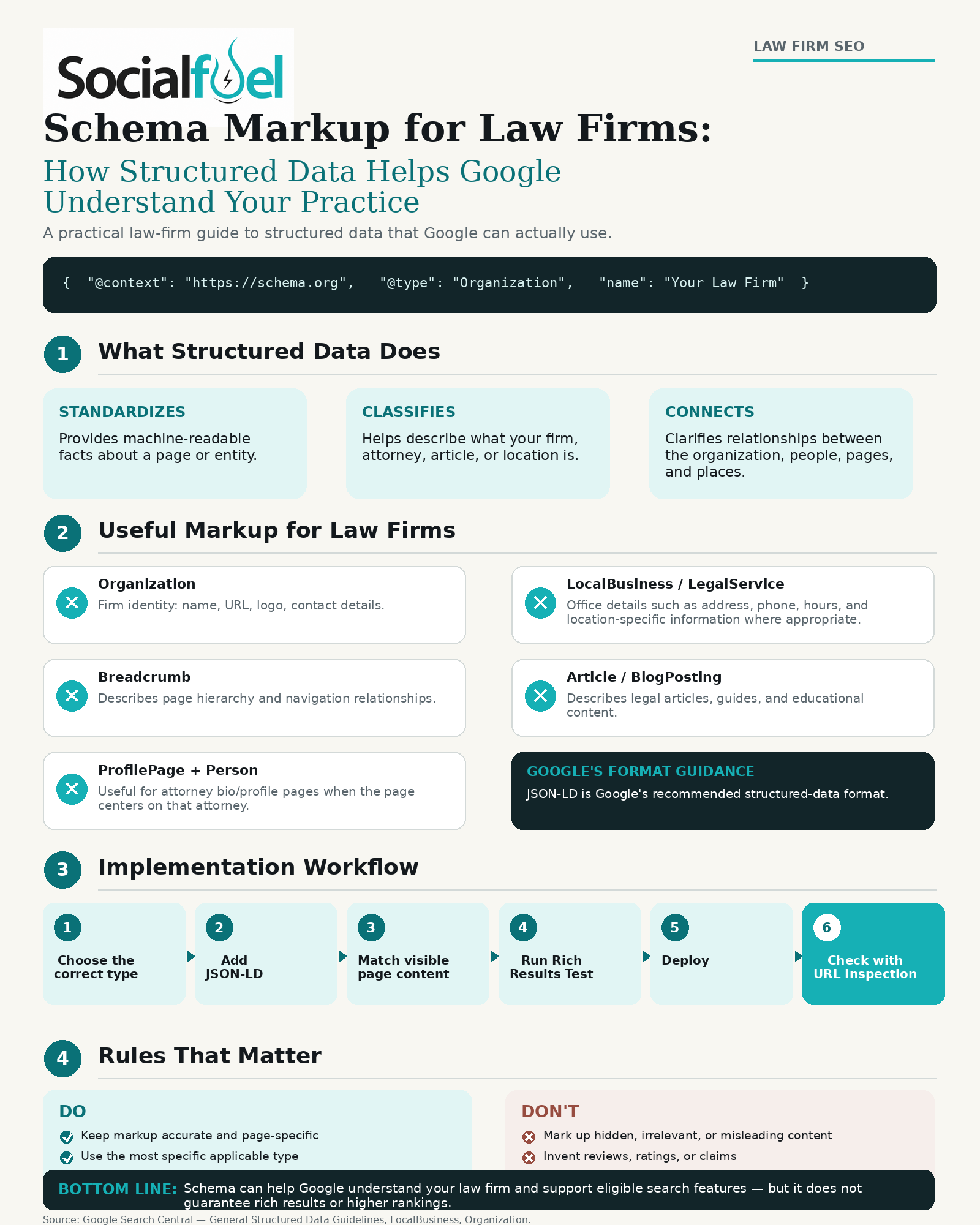
A practical schema implementation workflow
- Audit what already exists. Inventory theme, plugin, page-builder, SEO-plugin, and custom structured data. Look for duplicates, conflicts, invalid markup, and stale information.
- Map the real entities. Confirm the approved firm name, canonical domain, offices, attorneys, practice areas, biography URLs, public profiles, and contact details before writing code.
- Choose page-appropriate types. Use the most specific appropriate type when Google or schema.org guidance supports it, but do not add types just to make the markup look more sophisticated. 4. Create consistent JSON-LD. Reuse stable @id values and connect Organization, Person, office, article, service, and breadcrumb entities where the relationships are real.
- Validate the code. Google recommends the Rich Results Test for Google-supported features and the Schema Markup Validator for generic schema.org validation. [9]
- Deploy a small set first. After launch, use Search Console URL Inspection to confirm Google can access the page and see the implementation. [4]
- Monitor after templates change. A redesign, plugin update, attorney departure, office move, new phone number, or content migration can make previously valid markup stale or inconsistent.
Seven schema mistakes law firms should avoid
| Mistake | Why it is a problem |
| 1. Turning service areas into fake offices | Structured data should reflect real locations. Marking every target city as a LocalBusiness location creates inaccurate business information. |
| 2. Treating every attorney as a LocalBusiness | An individual lawyer is usually better represented as a Person on a profile page unless there is a genuinely separate business/location context. |
| 3. Publishing invisible claims in JSON-LD | Google says markup should describe content visible on the page. Hidden awards, credentials, ratings, or services are not a shortcut. [2] |
| 4. Expecting FAQ or review stars on demand | Rich-result eligibility is controlled by Google and changes over time. Schema can be valid without producing a visual enhancement. [2][8] |
| 5. Duplicating entities across plugins | Conflicting Organization, LocalBusiness, and Person nodes can create inconsistent names, URLs, phone numbers, and identifiers. |
| 6. Adding every schema type available | More markup is not automatically better. Use types and properties that accurately describe the page and its main entities. |
| 7. Never updating markup after firm changes | Attorney departures, office moves, phone changes, renamed practice groups, and redesigned templates can leave stale structured data behind. |
What about AI search, AEO, and GEO?
Structured data can be part of a clean technical foundation, but there is no special law-firm schema that guarantees inclusion in AI Overviews, AI Mode, or another generative answer. Google’s current guidance says the same core SEO best practices continue to apply to its AI features and that there are no additional requirements or special optimizations needed to appear. [10]
Google’s generative-AI optimization guidance also warns against overfocusing on structured data: it is not required for generative AI search, and there is no special schema.org markup that must be added. [11] That does not make schema useless. It means schema should do its real job – describe entities and eligible search features accurately – while the firm still invests in useful content, technical accessibility, links, reputation, and clear authorship.
Do not buy “AI schema” as a magic product. Ask exactly what markup will be added, what entity or page it describes, and which Google feature – if any – officially supports it.
How to measure whether schema implementation worked
The first success test is technical: the markup is present, accurate, non-conflicting, and valid for the intended vocabulary. The second is search eligibility: supported items appear as valid in Google’s testing and Search Console reports where those reports exist. The third is business context: search appearance and click behavior should be monitored alongside qualified calls, forms, consultations, and signed matters.
Do not attribute every ranking change to schema. Google’s own general structured-data guidance says a structured-data manual action affects eligibility for rich results rather than ordinary web ranking. [2] Structured data can help Google understand content and can support eligible search features, but it is one component of a much larger SEO system.
Where SocialFuel fits
SocialFuel’s current Schema Markup Implementation for Law Firms is a $4,000 one-time service. It includes an agreed schema review, custom JSON-LD, implementation, validation, and initial post-deployment checks. It is not a monthly subscription. [12]
The service is built around law-firm entities: the organization, attorneys, real offices, legal services, articles, and relevant page relationships. We review existing markup, map approved firm details into custom JSON LD, validate the implementation, deploy it to the agreed pages or templates, and document what needs to be updated when the firm changes. [12]
Schema implementation is separate from the $2,000 Technical SEO Audit, the $4,000 Website Speed Optimization service, the $5,000 Internal Linking Audit & Cleanup, and website redesign or migration work. If another technical problem is preventing crawling or indexing, schema alone will not repair it. [12]
Scope note: The $4,000 project buys implementation and initial verification. It does not promise rankings, rich results, review stars, FAQ expansions, AI recommendations, or signed cases.
Frequently asked questions about law firm schema markup
Does schema markup directly improve rankings?
Do not treat it as a direct ranking guarantee. Google says structured data helps it understand page content and can make pages eligible for supported rich results, but eligible markup does not guarantee a rich result or a higher position. [1-2]
Is JSON-LD better than Microdata?
Google supports JSON-LD, Microdata, and RDFa for structured-data features, and recommends JSON-LD. [2] It is often easier to maintain because the structured data can be managed in a dedicated script block.
Should every attorney have Person schema?
Attorney biography pages are a natural place to represent the attorney as a Person, and Google’s ProfilePage guidance supports Person or Organization as the main entity of a profile page. [5] The markup still needs to match the visible biography.
Should a law firm use LocalBusiness or Organization?
It depends on the page and entity. Google recommends the most specific applicable subtype, and local businesses can use the LocalBusiness guidance in addition to organization details. [3-4] Real offices and organization-level identity should not be conflated.
Can FAQ schema make our FAQs appear under the result?
For most law firms, do not expect that. Google says FAQ rich results are generally shown only for well-known, authoritative government and health websites. [8]
Does schema help ChatGPT or Google AI recommend the firm?
No implementation can guarantee that. Google says its AI search features do not require special schema, and structured data should remain part of the overall SEO foundation rather than an AI shortcut. [10-11]
Make the website describe the same law firm everywhere
The strongest structured-data implementation is usually not the one with the most code. It is the one that accurately represents the firm, uses stable identities, keeps attorney and office facts consistent, matches the visible page, and follows the requirements of the search features the site actually wants to qualify for.
Start with truth, then structure it. Make the organization, attorneys, offices, services, and publications understandable as separate but connected entities. Validate the code, deploy carefully, monitor after changes, and keep expectations grounded in what Google actually supports.
If your law firm needs the implementation handled end to end, SocialFuel offers Schema Markup Implementation for Law Firms as a one-time $4,000 project.
Sources and implementation notes
1. Google Search Central, “Introduction to Structured Data Markup in Google Search”
2. Google Search Central, “General Structured Data Guidelines”
3. Google Search Central, “Organization Structured Data”
4. Google Search Central, “Local Business Structured Data”
5. Google Search Central, “Profile Page Structured Data”
6. Google Search Central, “Article Structured Data”
7. Google Search Central, “Breadcrumb Structured Data”
8. Google Search Central Blog, “Changes to HowTo and FAQ Rich Results”
9. Google Search Central, “Structured Data Testing Tools”
10. Google Search Central, “AI Features and Your Website”
11. Google Search Central, “Guide to Optimizing for Generative AI Features”
12. SocialFuel, “Schema Markup Implementation for Law Firms,” approved 2026 service materials, pages 1–3. (Internal document; a clickable link requires the document URL.)
External Google sources checked September 9, 2026. Structured-data features and eligibility rules can change. Schema markup, rankings, rich results, AI citations, leads, and business outcomes are not guaranteed.