
When a prospective client searches for a lawyer nearby, Google may show a map and local business results before the traditional organic listings. For law firms, that means local SEO is not a side project. It is the work of making the firm easy to understand, eligible to appear, credible enough to choose, and measurable when a call or form comes in.
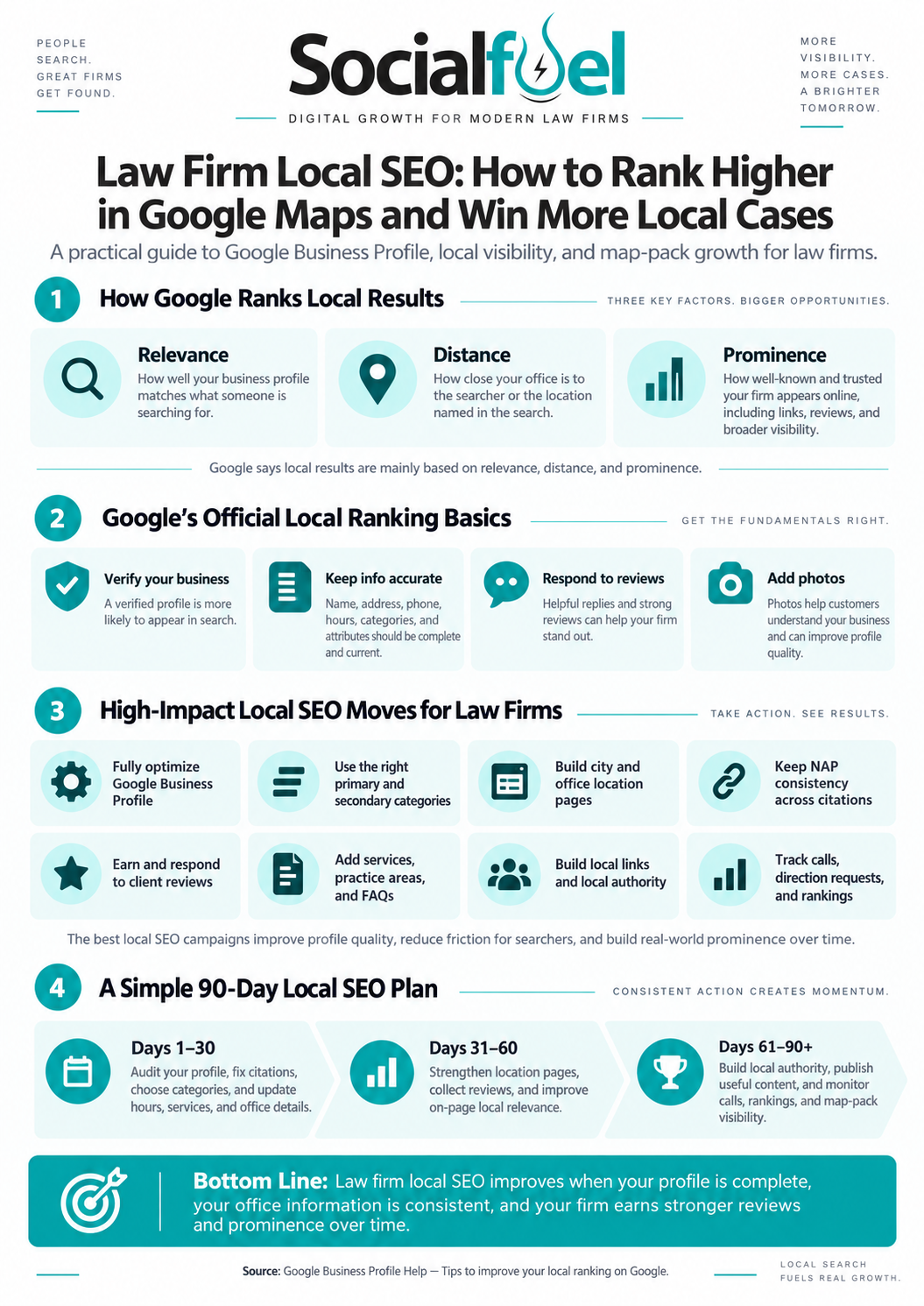
Google does not publish a checklist that guarantees a Map Pack position. Its own local-ranking guidance centers on relevance, distance, and prominence, and Google explicitly says there is no way to request or pay for a better local ranking.[1]
The practical goal is therefore not to chase a secret ranking trick. It is to build a complete, policy-compliant local presence that matches what the firm actually does and where it actually operates, while strengthening the website, reviews, links, and intake systems around that presence.
What actually determines local visibility?
| Factor | What Google means | What a law firm can work on |
| Relevance | How closely the Business Profile matches what the searcher wants. | Accurate categories, services, profile details, practice-area pages, and useful local content. |
| Distance | How far the business is from the searcher, or from the location named in the search. | A legitimate office footprint and accurate address. You cannot optimize away physical geography. |
| Prominence | How well-known and established the business appears. | Reviews, positive ratings, links, real-world references, reputation, and broader web authority. |
Important: A local SEO agency can improve the signals you control. It cannot manufacture proximity, force Google to rank a profile, or guarantee a signed case.
Start with eligibility, verification, and accurate business information
Before trying to improve rankings, make sure the profile is eligible and correctly represents the firm. Google says verified businesses can manage how their information appears on Maps and Search, and complete, accurate information is more likely to show for relevant local searches.[1][8]
For a law firm, the basics should be boringly consistent: the real-world firm name, the office address, a phone number that reaches that location, the correct website URL, current hours, and the most specific categories that actually describe the practice. Google specifically advises
businesses to use as few categories as possible and to choose categories that represent the core business rather than stuffing categories with keywords.[2]
Address compliance matters. Google requires the address or service area to be accurate and precise. A virtual office is not an eligible location merely because mail can be received there; Google says a virtual office must be staffed during business hours to qualify, and
storefront-style locations should be staffed and able to receive customers during the stated hours.[2]
- Do: use the firm name clients see on signage, stationery, the website, and legal marketing materials.
- Do: keep address, phone, hours, website, and category data current after moves, rebrands, or phone changes.
- Do not: add city names, practice areas, or marketing phrases to the business name unless they are genuinely part of the real-world name.
- Do not: create profiles for unstaffed satellite offices simply to appear closer to searchers.
| Timing note: Google says changes to business information can take up to about three days to appear, while rankings for a new business can take up to about a month to
emerge in search results.[8] |
Build relevance around the matters clients actually search for
Relevance starts with the Business Profile, but it should not end there. Google compiles business information from the profile, the official website, publicly available web content, third-party sources, and user contributions.[4] That makes your website part of the local-entity picture.
Each major practice area should have a useful page that explains the service, the problems it solves, who the firm serves, the jurisdiction involved, and the next step. For example, a personal injury firm may need distinct pages for car accidents, truck crashes, premises liability, and dog bites. An immigration practice may need separate pages for family-based petitions, adjustment of status, naturalization, asylum, or removal defense.
Local pages should also be genuinely local. A useful Houston page can explain where the firm is located, how consultations work, what courts or jurisdictions are relevant when appropriate, which communities the firm serves, and how that practice area intersects with Texas law. It should not be a city name swapped into the same paragraph fifty times. Google classifies multiple substantially similar city pages that funnel users to the same destination as doorway abuse, and its people-first guidance warns against mass-produced pages that add little value.[6]
Structured data can support clarity, too. Google recommends Organization markup and, for businesses with a real-world local presence, the most specific applicable LocalBusiness subtype together with useful properties such as name, address, telephone, URL, and logo.[7] Structured data helps describe the business; it is not a substitute for a legitimate profile or useful page content.
Treat categories and services as a description system, not a keyword field
Google Business Profile categories help determine what kind of business a profile represents.
Choose the most specific primary category that fits the firm, then add only relevant secondary categories. Google explicitly warns against using categories solely as keywords.[2]
Where the profile allows services, list actual services prospective clients can understand. Google says service businesses in eligible categories can add offerings to their profiles, and
those services may be highlighted when local customers search for something the business provides.[1]
The same principle should carry across the website: use the words clients use, but make the page useful after the click. “Houston immigration attorney” may be a target phrase; the page still has to explain what the attorney does, who may qualify, what the process looks like, and how to contact the firm.
Build prominence with reviews, links, citations, and real reputation
Prominence is where local SEO becomes broader than the Business Profile. Google says prominence is influenced by how well-known a business is, including information such as links
to the business and the number of reviews. More reviews and positive ratings can help local ranking.[1]
For law firms, the safest review program is simple: ask real clients for honest feedback at an appropriate point in the relationship, make the request easy, and respond professionally. Google permits businesses to share a review link or QR code, but it prohibits offering free or
discounted goods or services in exchange for a review, a changed review, or removal of a negative review.[3]
Attorney review replies require extra care. Do not disclose case facts, confidential information, or details that confirm a reviewer is or was a client when that would create an ethics or privacy problem. A short, respectful response that moves a complicated issue to a private channel is usually safer than litigating the review in public.
Citations and links are separate but complementary. Keep the firm name, address, phone, and website consistent across legitimate attorney directories, local business listings, bar or association profiles, and other relevant sources. Then pursue links and mentions that have a real reason to exist: legal publications, local organizations, community initiatives, useful scholarship or educational resources, original research, and expert commentary.
| Do not confuse
A hundred low-value directory entries are not automatically better than a volume with smaller set of accurate listings plus credible local and legal references. The authority: goal is consistency, discoverability, and trust – not a vanity citation count. |
Distance is a real constraint – plan around it honestly
Distance is the factor many firms try to “SEO around,” but Google makes clear that proximity is part of local ranking.[1] That means a downtown office may have a natural advantage for some nearby searches while a suburban office may be closer to a different set of searchers. The map results can change as the searcher moves.
The strategic response is not to invent offices. It is to decide which geography the firm can serve credibly, make the real location clear, build useful pages for the markets that matter, and invest in organic visibility as well as Maps. A firm can rank organically for a city or topic even when it does not occupy the closest map position, provided the content and authority are strong enough.
If the firm has multiple legitimate offices with separate staff, each location may deserve its own
profile and location page. If a location is not genuinely staffed or customer-facing, do not treat it as a ranking asset. Google can suspend profiles that violate representation guidelines.[2]
Use photos and profile completeness to reduce friction after you are found
Ranking is only half the problem. Once a prospective client sees the profile, the information has
to make the firm feel real and easy to contact. Google recommends adding photos and videos to help complete the profile and show customers what the business offers.[1]
For a law firm, useful imagery can include the actual office exterior, reception area, attorneys, meeting spaces, accessible entrance, and parking context – provided the firm has the rights and approvals to use the images. Avoid fake office photography that creates a mismatch with the real location.
Keep the website landing page equally clear: visible phone number, fast mobile performance, an intake form that works, attorney credentials, practice-area information, office details, and a direct path to consultation. Local SEO cannot rescue a conversion experience that makes the client work to reach you.
Measure local SEO as a client-acquisition system
Google Business Profile performance reports show how people discover a verified profile and
what they do after finding it. Available metrics can include views, search terms, and profile interactions, with date ranges that let owners compare performance over time.[5]
Use that data as the top of the funnel, not the final score. Connect it to website analytics, call tracking, intake notes, consultations, and signed matters. A useful law-firm local SEO report should answer questions such as:
- Which local search terms are producing visibility?
- Which practice-area and location pages generate qualified calls or forms?
- Which calls are new prospects versus existing clients, vendors, or spam
- Which consultations become signed matters, and which practice areas generate the strongest economics?
- Are reviews, rankings, traffic, and intake outcomes moving in the same direction?
A practical 90-day local SEO plan for a law firm
| Window | Primary work | What to verify |
| Days 1-30 | Claim/verify the Business Profile, correct NAP, categories, hours, website URL, office eligibility, tracking, and the highest-priority website pages. | The profile represents the real firm;
calls/forms work; no duplicate or ineligible locations are being used. |
| Days 31-60 | Improve practice and location content, add services and photos, clean citations, establish a
review-request process, and correct major website inconsistencies. |
Profile details and website details agree; local pages add real value; review requests are policy-compliant. |
| Days 61-90+ | Build local/legal links, publish useful local content, monitor review and ranking patterns, and connect profile interactions to intake and signed-case data. | The campaign is producing measurable visibility and a clearer picture of qualified opportunity – not merely more impressions. |
Common local SEO mistakes law firms should avoid
Keyword-stuffing the Business Profile name. Use the real-world business name, not a string of practice areas and city names.
Using virtual or unstaffed offices as map-ranking shortcuts. Eligibility and staffing rules still apply.
- Creating dozens of thin city pages. Build pages only where the firm can add genuine local value.
- Buying or incentivizing reviews. Google treats incentivized review activity as fake or misleading engagement.
- Ignoring negative feedback. Respond professionally, protect confidentiality, and use recurring themes to improve intake or service.
- Reporting rankings without intake outcomes. Visibility matters only if the firm can identify qualified inquiries and signed matters.
Where SocialFuel fits
SocialFuel is built specifically for law firms. Our current Law Firm Local SEO service is $3,000
per month and includes Google Business Profile management plus local strategy, content, reporting, and local link building.[9]
For Local SEO clients whose existing Google Business Profile is below 4.5 stars, SocialFuel requires the separate $1,500/month Law Firm Reputation Management service. That is a SocialFuel service requirement, not a Google rule, and review removal or rating improvement is never guaranteed.[9]
The point of the package is not to sell a magic Maps switch. It is to manage the pieces that a law firm can actually control: accurate local information, useful content, reviews and reputation, local authority, reporting, and the connection between visibility and intake.
| Bottom line: Local SEO works best when the firm is legitimate, easy to understand, easy to trust, and easy to contact. Build relevance honestly, respect distance,
strengthen prominence over time, and measure the calls and cases that follow. |
Frequently asked questions about law firm local SEO
Can I pay Google to rank higher in the Map Pack?
No. Google says there is no way to request or pay for a better local ranking. Paid ads are a separate product from organic local rankings.[1]
How fast will Google Business Profile changes show?
Google says edits can take up to about three days to appear in search results, while a new business can take up to about a month to establish rankings. Those are platform timing notes, not promises of a particular position.[8]
Do more reviews always mean a higher ranking?
No. Google says review volume and positive ratings can help local ranking, but local results still involve relevance, distance, and prominence together.[1]
Should every practice area have a separate page?
Usually the important services deserve dedicated pages when the firm can provide a complete, useful answer. Avoid mass-producing pages that differ only by a keyword or city name.
Can a virtual office help me rank in another city?
Not as a shortcut. Google says service-area businesses cannot list a virtual office unless it is staffed during business hours, and locations need to comply with representation guidelines.[2]
What should I track besides rankings?
Profile search terms, views and interactions are useful leading indicators. For business value, connect them to qualified calls, forms, consultations, and signed matters.[5]
Sources and implementation notes
1. Google Business Profile Help, “Tips to Improve Your Local Ranking on Google”. Checked September 9, 2026.
2. Google Business Profile Help, “Guidelines for Representing Your Business on Google”. Checked September 9, 2026.
3. Google Business Profile Help, “Tips to Get More Reviews”. Checked September 9, 2026.
4. Google Business Profile Help, “Understand How Google Sources and Uses Information in Business Profiles and Local Search Results”.
5. Google Business Profile Help, “Understand Your Business Profile Performance and Insights”.
6. Google Search Central, “Spam Policies for Google Web Search” (doorway abuse and scaled content) and “Creating Helpful, Reliable, People-First Content”.
7. Google Search Central, “Organization Structured Data” and “Local Business Structured Data”.
8. Google Business Profile Help, “Find Your Business on Google”.
SocialFuel, “Frequently Asked Questions” — Approved 2026 service and billing materials, pages 1–3. (Internal document; add its direct link if available.)