
 Digital marketing has become non‑negotiable for law firms. Your prospective clients search on Google first, compare options, read reviews, and often contact the first few firms they see. That reality has driven lawyers into increasingly expensive Google Ads (PPC) auctions—especially in personal injury, criminal defense, and family law.
At the same time, firms that quietly invested in organic search (SEO) five to ten years ago now enjoy a steady stream of high‑quality leads at a fraction of today’s PPC costs.
Below, we walk through the economics behind legal ad spend—CPCs, conversion rates, and long‑term ROI—using data, examples, and real‑world stories attorneys share on Reddit and X. Only after laying out the numbers do we move to recommendations and what this means for your firm’s next step.
Why Lawyer CPCs Are So High
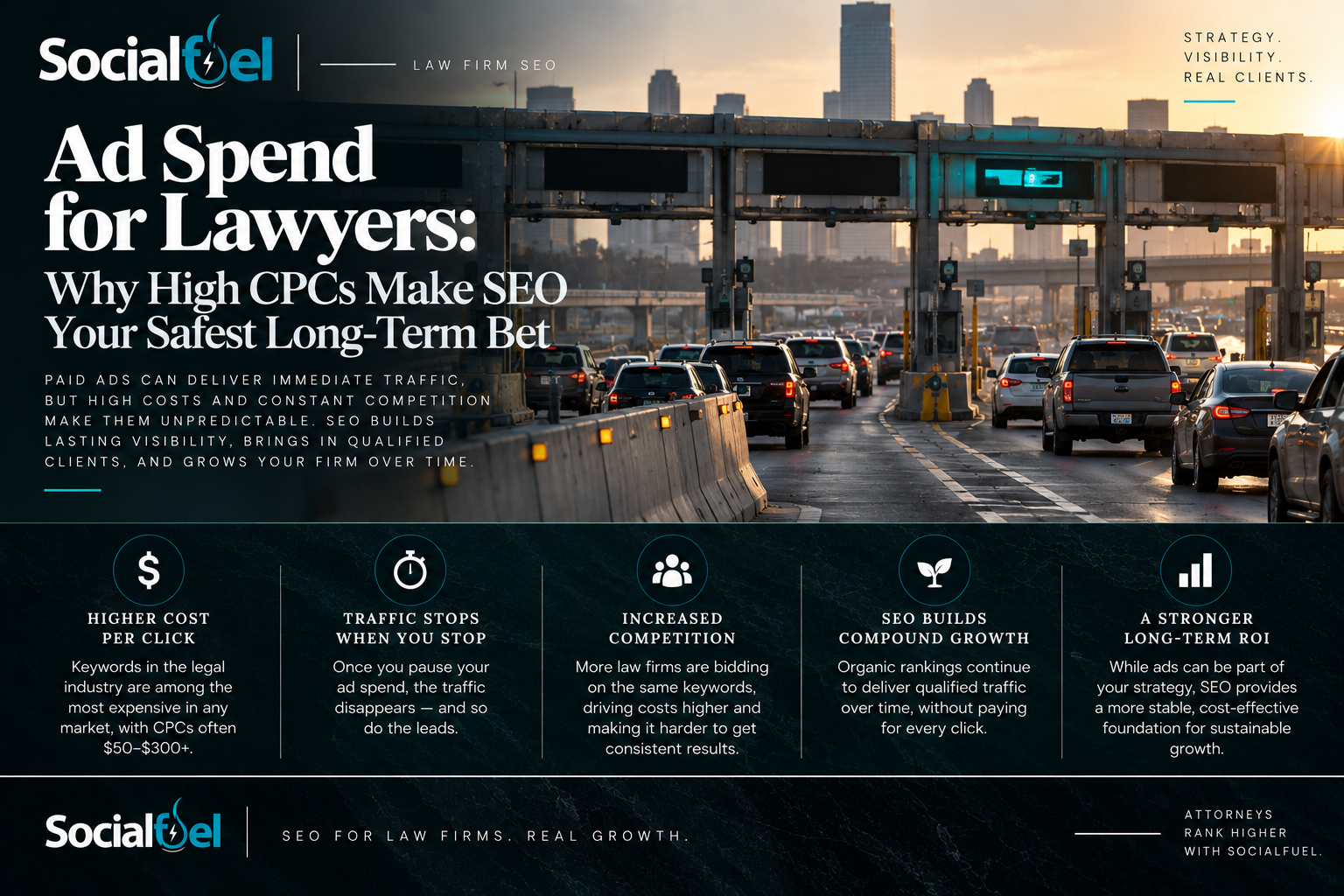
Legal is one of the most competitive and expensive verticals in Google Ads. Across the U.S., it’s common to see:
- $500–$750+ per click for “car accident lawyer,” “truck accident attorney,” “DUI lawyer,” and similar high‑value terms
- $150–$250 per click for family law, estate planning, immigration, and employment law in major metros
Four core factors drive these numbers:
- High case and lifetime value A single signed personal injury case can be worth tens of thousands of dollars in fees. That makes a $150 click rational—if and only if the funnel from click to signed case is tight.
- Finite search volume There are only so many “near me” and “best lawyer in [city]” searches in a given month. When dozens of firms compete for the same finite pool, bids escalate quickly.
- Big‑budget competitors Regional and national players often blanket entire states with massive PPC budgets. Smaller firms are forced to either out‑optimize or out‑spend them.
- Aggressive vendor models Many “legal marketing” vendors buy clicks in bulk, mark them up, and resell leads to firms. That extra layer can push the real effective CPC even higher.
As several attorneys have openly complained on Reddit’s r/legalmarketing and similar communities, it’s not unusual to see firms:
- Spend $15,000–$30,000/month on Google Ads
- Receive “plenty of clicks” and “some calls”
- Sign only a handful of real cases, often at a five‑figure cost per signed client
In that context, conversion rate and intake performance—not raw click volume—determine whether PPC is a profit center or a money pit.
PPC Conversion Rates for Attorneys
A high CPC can still be profitable if enough of those clicks convert into consultations and cases.
Industry benchmarks for law firms on the Google Search Network generally show:
- Average PPC conversion rate (click → lead): ~6–10%
- WordStream’s Google Ads Industry Benchmarks historically place legal search around 6–7% [placeholder].
- Well‑optimized legal campaigns often achieve 8–12%+ when tightly focused on high‑intent terms and supported by strong landing pages.
- Typical PPC cost per lead (CPL):
- $150–$400+ in many practice areas
- $300–$800+ in highly competitive PI and mass tort campaigns (Agency and platform data, 2022–2024 [placeholder])
In real‑world terms:
- A personal injury firm paying $120 per click and converting at 8% is paying $1,500 per lead. If they sign 1 of 5 leads, their cost per signed case is ~$7,500 before overhead.
- A criminal defense firm paying $50 per click and converting at 10% has a $500 CPL. If they sign 1 of 3 leads, cost per case is ~$1,500.
On platforms like X (formerly Twitter) and Reddit, attorneys routinely share similar experiences:
- One solo PI lawyer described burning through $10,000+ in three months with a generalist PPC agency, landing “a bunch of tire‑kickers and one low‑value case”.
- Another firm reported that after an aggressive PPC push, 40–50% of calls were irrelevant (wrong jurisdiction, no injury, no fault), driving cost per quality lead far higher than the raw CPL metrics suggested.
These stories are not outliers; they reflect the reality that high CPCs magnify every inefficiency in your funnel. Weak targeting, generic ad copy, slow intake, or underperforming landing pages quickly destroy ROI.
SEO: Conversion and Long‑Term Value
SEO works on a different economic model. You invest in:
- Technical optimization and site structure
- High‑quality, practice‑area‑specific content
- Local SEO (Google Business Profile, reviews, citations)
- Strategic link building and digital PR
Organic Conversion Rates for Law Firms
Conversion rates from organic traffic are often comparable to—sometimes better than—PPC, especially when users land on:
- Well‑optimized practice area pages
- Local service pages (“Divorce Lawyer in [City]”)
- Helpful articles that answer specific questions and funnel visitors to clear calls‑to‑action
Across legal sites we and others have audited:
- Organic conversion rate (click → lead) commonly falls in the 3–8% range
- Top‑performing pages can exceed 10–15% for local, high‑intent traffic (Agency data and industry benchmarks, 2022–2024 [placeholder])
Attorneys who’ve invested in SEO are candid about the payoff. In multiple Reddit threads and X discussions, you’ll see comments along the lines of:
- “We cut our Google Ads budget in half after our organic rankings improved. Now 60–70% of our new cases come from SEO and referrals instead of paid leads.”
- “Our best cases almost always say they found us ‘on Google’ and read a couple of our articles—not that they clicked an ad.”
The key distinction: SEO results compound over time:
- A strong “Car Accident Lawyer in [City]” page can drive leads for years.
- Informational content ranks for dozens of long‑tail queries you’d never bid on in PPC.
- Your brand searches (“[Firm Name] reviews,” “[Firm Name] injury lawyer”) increase, making all channels more efficient.
While Google’s algorithm updates require ongoing strategy, firms that commit to SEO typically watch their effective cost per lead fall every year, while PPC costs often rise.
Comparative Analysis: PPC vs. SEO for Lawyers
Budget and Cost Control
PPC
- Pros:
- Tight control over daily/monthly spend
- Easy to pause, scale, and test quickly
- Cons:
- High and volatile CPCs
- You are effectively renting visibility; turn off ads and your pipeline dries up
SEO
- Pros:
- No incremental CPC; each additional click reduces your effective cost
- Builds durable assets: content, links, authority, and brand recognition
- Cons:
- Requires consistent investment regardless of short‑term lead spikes or dips
- Results take time; not a “flip the switch” channel
Speed to Lead Generation
- PPC: Fast. You can generate traffic and leads within days of launch.
- SEO: Strategic. In competitive markets, it can take 6–12+ months to rank for major terms—but the payoff accrues for years.
Lead Quality and Buyer Journey
Both channels can reach motivated prospects, but:
- PPC often captures bottom‑of‑funnel searches (“hire,” “near me,” “free consultation”).
- SEO captures the full journey:
- Researching (“Do I need a lawyer after a minor car accident?”)
- Evaluating (“How much does a DUI lawyer cost?”)
- Hiring (“DUI lawyer [City] with payment plans”)
Because SEO lets you educate prospects before they call, organic leads often come in warmer and more trusting—something many attorneys now acknowledge publicly on social platforms.
Long‑Term Firm Value
Viewed over a 3–5 year horizon:
- Heavy PPC‑only strategies leave you exposed to rising costs, competitor campaigns, and platform policy changes.
- A SEO‑first, PPC‑supporting strategy gives you:
- A defensible position in organic results
- Lower long‑term cost per lead
- A more valuable firm asset if you ever expand, merge, or sell
Strategic Recommendations for Law Firms
Only after considering the above should you decide where to lean with your next marketing dollar.
1. Treat PPC as a Tactical Tool, Not Your Foundation
PPC has a role:
- Launching a new firm or practice area
- Filling short‑term gaps in your pipeline
- Testing messages and offers you’ll later build into your SEO content
But in a world of $50–$150+ CPCs, relying on PPC as your primary growth engine is risky. As countless lawyers on Reddit and X have discovered the hard way, a few months of poor campaign management can burn through $20,000–$50,000+ with little to show for it.
If you run PPC at all, insist on:
- Transparent reporting (keyword‑level ROI, not just “leads”)
- Dedicated, conversion‑optimized landing pages
- Alignment between the ad promises, intake scripts, and actual case criteria
2. Make SEO the Core of Your Growth Strategy
Our strong recommendation—for most firms in most markets—is to treat SEO as your primary, long‑term acquisition channel, supported (not dominated) by PPC.
That means:
- Building a technically sound, fast, mobile‑friendly site
- Creating authoritative practice area pages and FAQs that match real search behavior
- Optimizing your Google Business Profile and local signals
- Consistently publishing and promoting content that answers the questions your best clients actually ask
This is exactly where our agency focuses. We work with law firms to:
- Identify the keywords and topics that will matter 12–24 months from now, not just this week
- Build content and link strategies that steadily improve rankings for your highest‑value terms
- Turn that traffic into real consultations with clear CTAs, tracking, and intake alignment
3. Use Data to Rebalance Spend Over Time
We encourage firms to:
- Audit their current PPC and SEO performance (CPC, CPL, cost per signed case)
- Begin reallocating budget from low‑ROI PPC segments into SEO initiatives with compounding value
- Review performance quarterly, with a goal of having 50–70% of new cases originate from organic and branded search within 12–24 months
When that happens, attorneys routinely tell us the same thing: they sleep better knowing their pipeline doesn’t depend on tomorrow’s auction price.
Conclusion: Why Lean Toward SEO—and Why Work With Us
The legal ad market’s high CPCs make one thing clear: relying on rented traffic is an increasingly expensive way to grow. PPC can and does work, but the margin for error shrinks every year.
SEO, by contrast, builds an asset:
- It delivers competitive conversion rates without paying for every click.
- It compounds over time, steadily lowering your effective cost per lead.
- It attracts better‑informed, higher‑intent clients who often say, “I found you on Google and liked what I read.”
For most firms, the smartest move is to lean hard into SEO while using PPC selectively and surgically.
If your goal is to:
- Reduce dependence on expensive Google Ads
- Build a sustainable, defensible source of leads
- Know exactly which marketing dollars produce which cases
Our agency focuses exclusively on SEO for law firms, combining hard data, deep intake experience, and years of proven results turning organic visibility into signed cases. Because we partner with only one firm per practice area in each state, you’ll get true strategic exclusivity—not a cookie‑cutter campaign. If you’d like an honest, numbers‑driven review of your current PPC and SEO performance, along with a clear plan to move more of your growth into organic search, contact us for a no‑obligation audit.